

At Saint Martin’s Academy, a boy’s first introduction to what scholastic philosophers call the “great chain of being” happens in Natural History class, when the freshmen read Jean-Henri Fabre’s wondrous account of the life of insects. Speaking of the praying mantis, Fabre makes this startling observation:
It may well be that the Mantis, the Locust, the Ant, and even lesser creatures contribute to the strength of the human brain. In strange and unseen ways they have all supplied a drop of oil to feed the lamp of thought.
In a recent class, Dan Kerr mused that when a hunter eats a deer, that deer may well become the fuel of prayer. The lower levels of being find their fulfillment in the higher. Visible creation finds its voice in man to praise the One who created the order of nature before which we stand in awe.
The true hunter hunts for nourishment and must be a keen observer of creatures, especially when he uses the instincts of other creatures to track and trap his prey. Anyone who has hunted pheasant with birddogs has had a front row seat to the marvel of animal instinct, how they find the scent, then point, and ultimately retrieve, all the while showing such joy in displaying their talents before their master.
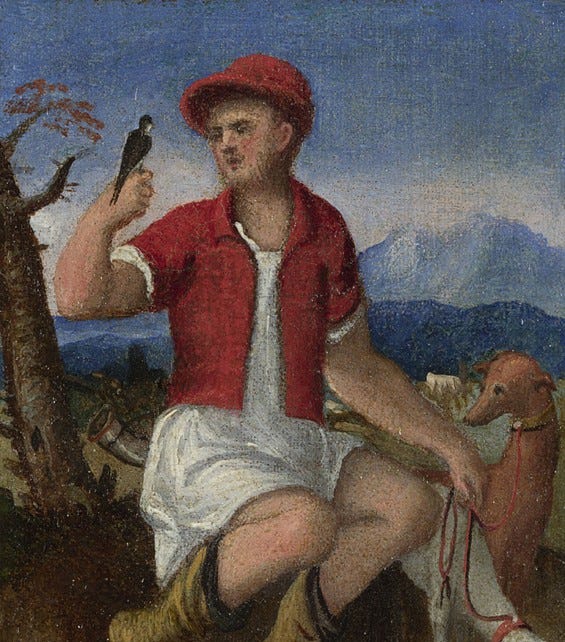
Master, indeed. Man’s mastery over nature is a gift from God and, —as his gifts often are—, also a task, a mission. Such stewardship requires careful attention, for ours is not an absolute dominion. We are caretakers of the property of God. Few labors bring this lesson home better than hunting, especially when using dogs, or even that marvel of marvels, the falcon.
In the Book of Job, there is a lovely poem that insistently asks where wisdom is to be found. To show us how far beyond us it is, God says, “No bird of prey knows that hidden path, no falcon’s eye has seen it.” (Jb 28:7 NIV) Even the best eyes of his creation cannot find it. When hunting with a falcon, we ask the world’s best eyes and swiftest swoop to help us find our food. In this case, the falcon has mastered the art. And it kills its prey for us as if its fledglings. To hunt with a falcon or a good birddog is to realize that “mastery” for each creature means bringing to fruition the gifts (and the consequent charge and responsibility) that God has given to each. If other creatures fill man’s lamp of thought, our task is to use our intellect and will as God intended. As the Athenian tells Clinias in Plato’s Laws, “To conquer self, of all victories, is the first and greatest.” (Book 1, 626e) The only thing we can really master is ourselves.
At St. Martin’s, our “Mastery Program” consists of several badges that the boys can earn in their freetime. The badges that have to do with October’s labor of the month are the Bowyer and the Deerslayer. To earn the former, a student must make his own bow from wood he harvests in the wild, string it, and shoot it hundreds of times until it proves true. For the latter, he must track and kill a deer, finally field-dressing it. In the school’s history, only one student has completed all of these steps. It requires mastery to be such a home-grown hunter, and this mastery of self entails yielding in wonder to the nature of the wood and the string, of the flight of the arrow, and of the elusive habits of the deer. One can only “master” nature by complying with the laws of nature.
In this way, education is a microcosm of life. The lessons we learn we must practice each day. This month, let us be on the hunt for occasions to wonder at nature, and then master ourselves by respecting the order of nature, principally the nature God has given each of us. Rooted in respect for creature and Creator, such contemplation is an act of devotion. For inspiration, let your heart in hiding stir for a bird, as you ponder Father Gerard Manley Hopkin’s poem “The Windhover,” dedicated to our Lord and in artful awe at the flight of the falcon.
The Windhover
By Gerard Manley Hopkins
To Christ our Lord
I caught this morning morning’s minion, king-
dom of daylight’s dauphin, dapple-dawn-drawn Falcon, in his riding
Of the rolling level underneath him steady air, and striding
High there, how he rung upon the rein of a wimpling wing
In his ecstasy! then off, off forth on swing,
As a skate’s heel sweeps smooth on a bow-bend: the hurl and gliding
Rebuffed the big wind. My heart in hiding
Stirred for a bird, – the achieve of, the mastery of the thing!
Brute beauty and valour and act, oh, air, pride, plume, here
Buckle! AND the fire that breaks from thee then, a billion
Times told lovelier, more dangerous, O my chevalier!
No wonder of it: shéer plód makes plough down sillion
Shine, and blue-bleak embers, ah my dear,
Fall, gall themselves, and gash gold-vermilion.
I’d liken to the amateur; someone who is doing it for the love of it. For the throbe of the chase. Any bird hunter out for nourishment- he gunna starve.
Hunting for nourishment but using the most inefficient methods possible…?